
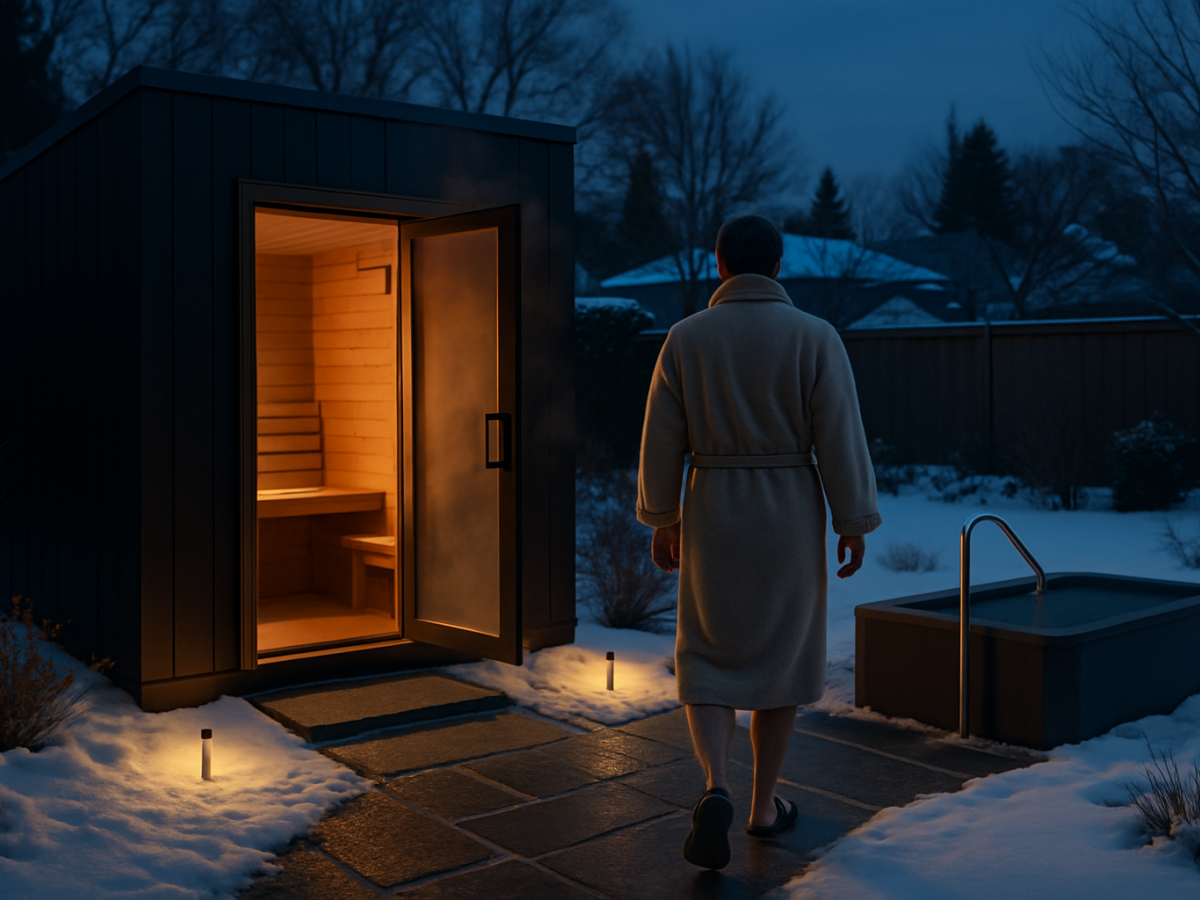
A sauna that works well in July can disappoint badly in January. Canada doesn't have one uniform climate, but in Winnipeg and across the prairies, an outdoor sauna has to handle deep cold, wind, snow, and repeated freeze-thaw cycles. It starts from a much colder baseline, has to recover heat every time the door opens, and has to manage and shed moisture properly after use.
For dependable, year-round use, the strongest choice is usually a traditional sauna inside a properly insulated cabin, with a correctly sized electric or wood-burning heater. The heater matters. The building around it matters just as much.
Traditional vs. infrared in deep cold
Infrared panels radiate heat directly at the body and generally run at lower room temperatures. A traditional heater warms the air, the stones, the benches, the walls, and the ceiling, and pouring water on the stones creates löyly, the wave of steam that defines traditional sauna bathing.
Infrared can make real sense for a compact, lower-temperature product indoors, in a home gym or finished basement. It's not automatically a poor choice. But for an outdoor Canadian sauna built around intense heat, steam, social use, and repeated hot-cold rounds, it's usually not the strongest option. In deep winter you want the whole room warm: hot air, warm benches, stones holding heat, and enough heater capacity to recover fast when people move in and out. A correctly sized electric or wood-burning heater delivers that in a way infrared isn't built to.
Electric usually suits city and suburban properties: convenient, controllable, easy to use regularly. Wood-burning suits rural properties, acreages, and lake lots, where fire and ritual matter and a large electrical run isn't practical. Either performs well when it's sized and installed correctly.
Insulated cabin vs. barrel sauna
Barrel saunas are popular for good reasons: a recognizable shape, a smaller interior volume, an approachable kit price. They can work for occasional users, sheltered sites, and smaller budgets. But the barrel shape doesn't solve the building-envelope problem. Most barrel designs use their wood staves as both interior finish and exterior shell, and even a leading barrel manufacturer recommends a solid base and exterior stain just to create a water barrier and improve longevity. That construction can work, but it gives the builder less control over insulation, air sealing, exterior drainage, roof detailing, weather protection, and long-term moisture management.
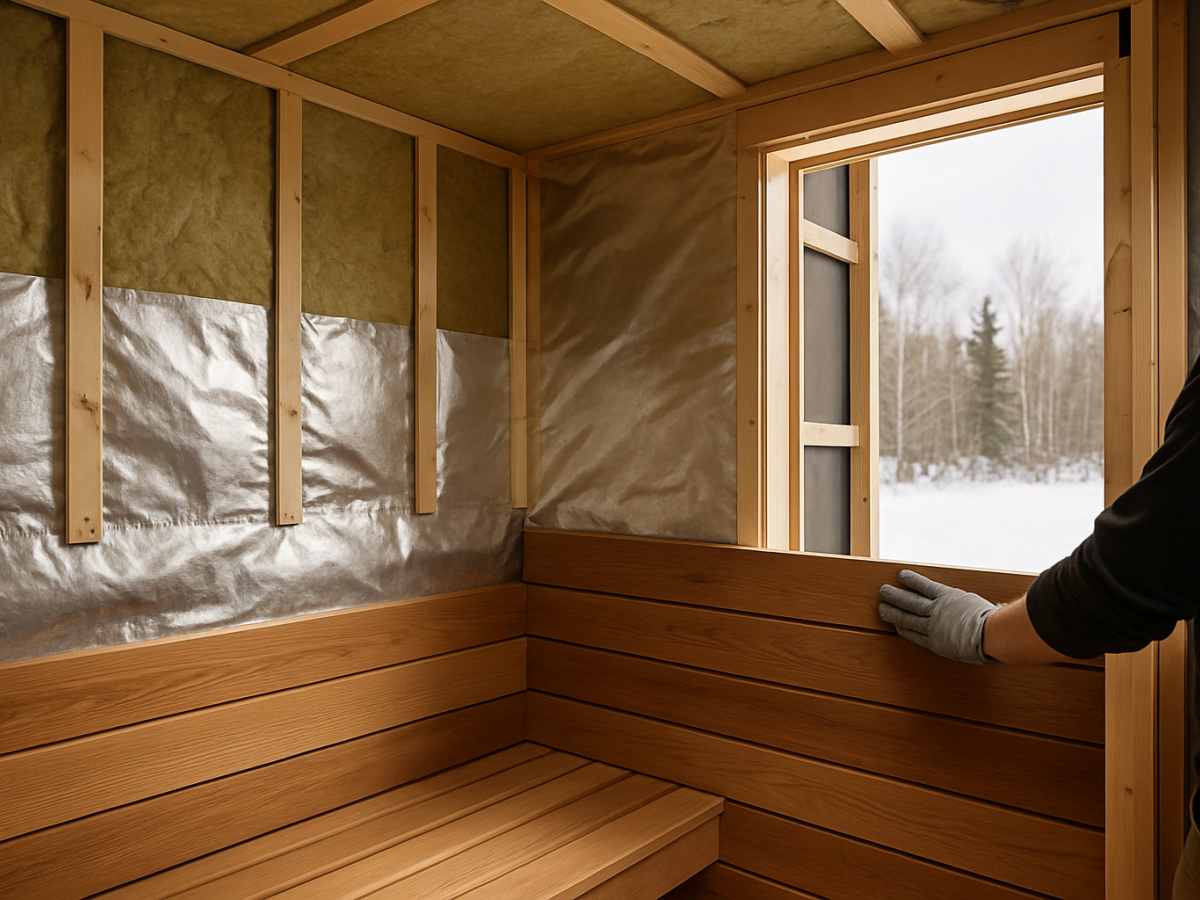
An insulated cabin allows a complete wall and ceiling system: framing, insulation, a sealed foil vapour-control layer, an interior air gap, tongue-and-groove cladding, exterior weather protection, a rainscreen, durable siding, and a real roof assembly. This isn't theoretical. Harvia's current outdoor cabin line uses insulated wall and ceiling elements specifically to hold heat steadier and run more efficiently, with one model using 80 millimetres of insulation inside 110-millimetre wall elements.
The geometry helps too. Flat walls and controlled ceiling height make it easier to build elevated benches, keep bathers' feet in the warmer air, and create layouts people can actually sit or lie down in comfortably. A barrel's curved walls cut into usable upper-level space and often force compromises on bench height, depth, and shoulder room. A small barrel might heat up faster because there's less air to warm, but a properly built cabin heats efficiently too, and delivers a much better room around it.
Heater size and glass have to be planned together
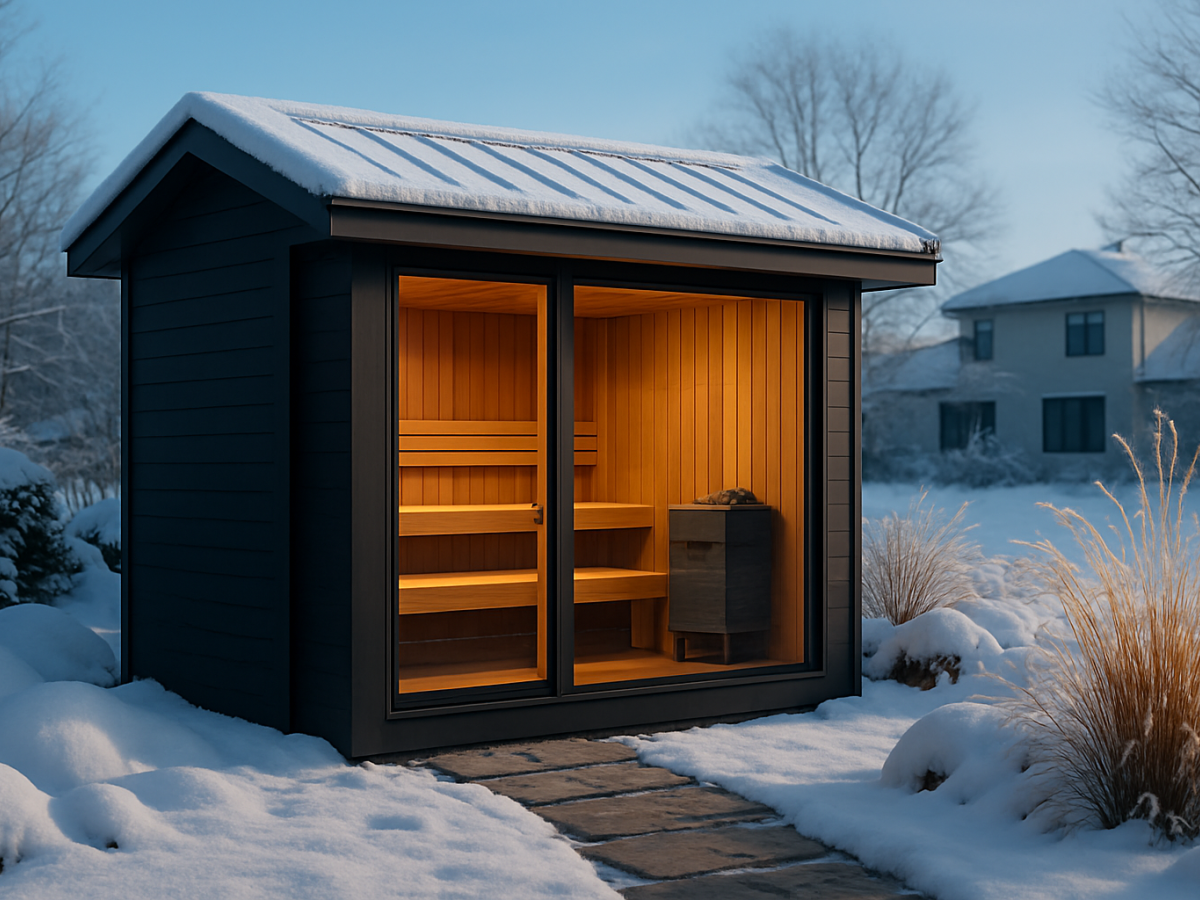
Large glass looks spectacular and it increases heater demand. Heater manufacturers don't size equipment off floor area alone. They calculate cubic volume, then account for glass, masonry, and other uninsulated or heat-absorbing surfaces. Harvia's current sizing guidance adds roughly 1.2 cubic metres of calculated room volume for every square metre of glass or similar surface, so even a single glass door can meaningfully change the required heater capacity.
The answer isn't to skip glass. It's to use it deliberately, built into the heater calculation and the insulation strategy from the start, whether that's a single view window, a glass door, or a full glass wall. Stone quantity, condition, arrangement, and airflow matter here too: too little heater capacity means long warm-ups, too much heater for the room heats the air fast without letting the stones store enough energy for a real steam experience. The heater has to be sized for the actual finished room, not a generic square-foot estimate.
Ventilation still matters in winter
A winter sauna gets air-sealed carefully, but that doesn't mean skipping ventilation. The room needs controlled fresh-air supply, exhaust, and a real drying strategy, all of which support breathing comfort, heat distribution, and moisture removal after use. Current HUUM North American heater manuals call for planned supply, exhaust, and drying ventilation, with required locations that shift depending on whether the sauna uses mechanical or gravity-based airflow. Random air leakage just wastes heat. Designed ventilation supports the room, and after every session, the vents, heater, floor design, drainage, and material choices all need to help it dry. Winter performance isn't only about how fast the sauna heats up. It's about how the building handles years of repeated hot-cold, wet-dry cycles.
Why traditional suits contrast therapy
Canadian winter puts cold air, snow, and a cold shower or plunge within arm's reach. Traditional sauna suits that ritual well because it produces a hotter room, heated interior surfaces, steam from the stones, and a more dramatic hot-to-cold transition. Research on Finnish sauna paired with cold-water immersion, including studies of acute cardiovascular and thermoregulatory response, and separate research on Scandinavian winter swimmers who regularly combine cold water with sauna use, doesn't prove every marketing claim made about contrast therapy, but it does confirm the hot-cold sequence creates a genuine physiological stress. Anyone with cardiovascular disease, an unstable medical condition, pregnancy-related concerns, or uncertainty about cold exposure should get individual medical guidance before starting an aggressive contrast routine. The property has to support the ritual safely too: a short, slip-resistant path, good lighting, privacy, drainage, and a cooling or plunge area that stays practical through winter.
What to prioritize when buying
Skip exterior colour, heater brand, and how it'll look on social media as a starting point. Start with the system: insulated walls and ceiling, careful air sealing, a continuous foil layer, an interior air gap, real exterior weather protection, a proper roof, and a foundation suited to the property. Confirm the heater is sized for the actual room volume, all glass surfaces, the interior materials chosen, expected winter use, the number of users, and the warm-up time and löyly experience you want. Ask how it'll be ventilated and how it dries after use. Look at bench heights, foot position, ceiling relationship, heater clearances, and how much usable seating space is actually there. Then ask who coordinates the electrical or chimney work, permits, and inspections, and whether the benches, floor sections, controls, and heater components can be serviced later. Those questions tell you whether you're buying a product off a shelf or getting a building designed for your site.
The Turon view
For serious, year-round use in Manitoba and across the Canadian prairies, an insulated custom cabin with a traditional electric or wood-burning heater is usually the strongest option. That doesn't mean every barrel sauna is bad or every infrared sauna is useless. It means a cabin gives us more control over the details that actually determine winter performance: structure, insulation, air sealing, ventilation, glass, heater sizing, bench geometry, exterior durability, moisture management, and how well it dries after each use.
A Canadian winter exposes shortcuts fast. A well-built sauna shouldn't just survive the cold. It should be one of the best reasons to own it. At Turon Saunas, we design around the property, the Manitoba climate, and how the client will actually use the space, so what you end up with is a cold-climate sauna system built to perform, not just a backyard structure that happens to get hot.
